 A reorg gets announced on Monday. By Friday, the new reporting lines are in place, the updated org chart is circulating, and everyone has a fresh set of meetings. In Before You Buy Leadership Training, Know Which Problem You Have, I talked about how performance problems do not all come from the same source.
The old weekly report is still due.
Everyone still stops for an approval step that the previous structure created.
Meanwhile, the project that leadership deprioritized six months ago still has people attending its status call, because nobody clearly shut it down.
That’s how change fatigue at work builds. The organization adds the new structure while quietly carrying the old one. People absorb another process, another priority, and another set of expectations without anything being removed.
I have seen this pattern create missed delivery dates, slow decisions, and uneven accountability across technology organizations. By the time the next year’s planning begins, leaders are estimating capacity with a team that is already carrying work from several past versions of the business.
Before you ask managers to commit to next year’s priorities, ask a harder question:
What did the last change take away?
Your reorg may still be running three operating models
Executives usually communicate change in terms of additions. They announce the new reporting structure, the new product model, the new approval process, and the capabilities the business now expects teams to build.
That information matters. It also leaves out the operational cleanup that determines whether the change can work.
Why the old work keeps running
When nobody names what ends, employees make their own decisions. Most will keep doing the familiar work because it once mattered, someone still asks for it, or stopping feels risky.
You might see an engineering manager still producing a weekly utilization report that no executive reads. In another corner, a product leader keeps routing roadmap decisions through a former steering group.
Somewhere else, an IT team maintains a standing review for an application that moved to another portfolio, while a delivery team keeps supporting a project that was technically deprioritized but never formally closed.
Each item can look small. Together, they consume attention that leaders assume is available for current priorities.
What carrying three operating models costs you
This is where change fatigue at work becomes an operating problem. People are forced to spend energy interpreting which version of the organization still applies. They attend meetings to protect themselves. They keep outdated approvals in place because they do not know who will object if they remove them.
Repeated reorganizations also create a credibility problem. If leaders announce a change and leave the old obligations intact, employees learn to wait. They watch to see which old requirements survive.
The same issue appears when decisions continue moving upward after a reorg. I wrote about that pattern in Why Every Decision in Your Org Ends Up on Your Desk. If authority changed on paper while the old approval habits stayed in place, the organization is still operating under the old structure.
How to find the work your last change forgot
Start with the managers who carry the operating details. Ask each one to identify what their team is still doing from before the last reorg, reprioritization, or leadership change.
Start by asking managers what is still on the books
Give them enough room to be specific. “We have too much work” will not help you make a decision. You need the names of the reports, meetings, approvals, projects, escalations, and support obligations that are still consuming time.
Ask questions such as:
- Which recurring report could stop without affecting a decision?
- Does an approval step still exist only because of the previous structure?
- Name any project that was deprioritized but still has active meetings, support, or deliverables.
- Who is still serving a stakeholder who no longer owns that work?
- What activity would disappear if nobody asked about it for 30 days?
- Which commitment has no clear owner under the current structure?
Stop, transfer, or keep
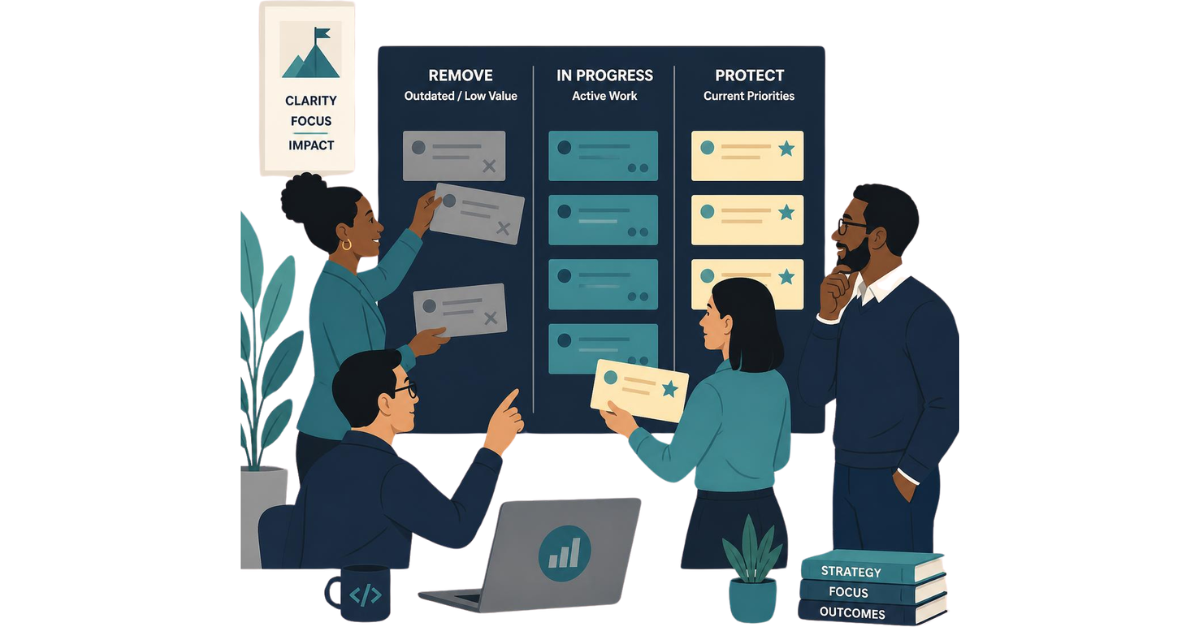
Then sort the answers into three decisions: stop, transfer, or keep.
“Stop” means the work ends. “Transfer” means the work continues under a different owner or process. “Keep” means the work remains necessary and has a current reason, owner, and review point.
Do not let “keep” become the default simply because it feels safer. Every retained activity should have a business purpose that someone can explain in one sentence.
A director can run this audit in a manager meeting, during quarterly planning, or through a short written exercise before a leadership review. I have seen this go sideways when leaders ask for the list and then sit on it.
Make the room safe enough for an honest answer
The format matters less than the follow-through. If managers list obsolete activities and nothing changes, the exercise will teach them that speaking up creates more work without producing a decision.
Use a simple script:
“For this review, list the work your team still carries from before the last change. Include reports, approvals, meetings, projects, and support commitments. We will decide what stops, what moves, and what stays. Do not defend an activity before we understand why it still exists.”
That last sentence matters. People often defend outdated work because they believe taking work away jeopardizes their job or they expect the activity to be challenged before the facts are considered.

How change fatigue at work quietly eats your capacity
A capacity plan built on the org chart alone will give you a false sense of precision.
Why the org chart overstates your capacity
The chart may show the right number of engineering managers, product leaders, and technical teams. What it will miss: two managers spending several hours each week preparing executive readouts that repeat information already available elsewhere. It also will not capture a senior architect still being pulled into decisions from a previous platform model, or a team supporting a retired product because no one communicated the end date to its users.
Those obligations rarely appear as separate line items. They show up as fragmented attention.
That makes planning for the next year vulnerable. Leaders may commit to new platform work, delivery dates, or product capabilities based on theoretical capacity. The team then misses milestones because its actual capacity includes old work that nobody counted.
The response is often another prioritization meeting. Those actions may help in specific cases, but they do not correct a planning model that treats unfinished work as invisible.
Capacity has at least three parts: the people available to do the work, the time available after existing commitments, and the decision space available to move work forward.
A team can have enough people and still lack capacity when approvals take too long. Open calendar space does not fix unresolved ownership questions that managers are still carrying. Even a clear project plan will not solve for old support obligations that keep interrupting delivery.
Four questions every priority must answer
When you prepare for next year, require each major priority to answer four questions: what current work will stop or reduce to make room, which team owns the outcome, what authority that team has to make decisions, and what evidence will tell you the commitment is at risk.
If the answer to the first question is “nothing,” the organization has not made room.
For a deeper look at how unfinished work quietly caps what a team can deliver, see Your Team’s Ceiling Is Your Bandwidth.
Accountability gets uneven when expectations stay unclear
Accountability weakens when people cannot tell which commitments still count.
The same missed commitment, three different responses
That creates a familiar pattern across leadership teams. One manager misses a delivery date and gets questioned immediately. Another manager misses a similar commitment and receives a private explanation or a revised deadline. A third manager avoids the issue because the work changed twice and nobody agreed on the current owner.
Leaders need clear answers about who owns the decision now, what “done” means under the new structure, and which work takes priority when two commitments compete. They also need to know what happens when a manager raises a capacity concern and what follows after a commitment is missed.
If those answers vary by manager, accountability becomes dependent on where someone sits and who they report to. That creates frustration for strong leaders and cover for leaders who have learned to wait out ambiguity.
Accountability requires more than a due date in a project tracker. It requires a current owner, a defined outcome, the authority to act, and a consistent follow-up process.
This is also where the director’s behavior matters. If you regularly step in to rescue a delivery commitment, rewrite an executive readout, or make a decision that belongs with a manager, you may be reinforcing the pattern. I covered a related leadership transition in You Promoted Your Best Engineer. Now Your New IT Manager Is Struggling.
A script you can use as written
Reset the expectations in plain language:
“You own this outcome. The authority that comes with it is yours. Here is what must be escalated. If the commitment is at risk, raise it by this date with your recommendation.”
Then use the same standard across the leadership team. If a commitment is missed, review what happened, what the owner knew, what authority was available, and what will change next time. Do not let the response depend on personality, proximity to the executive team, or who is most comfortable explaining the miss.
If a manager is struggling to see where ownership or decision authority is unclear, you can pass along my Find My Leadership Gaps quiz as a starting point for reflection.

What to do before the next change lands
Before announcing another structural change, complete the cleanup from the last one.
Ask your leadership team to bring forward the work that continues without a clear reason. Review it against current business priorities. Stop what no longer matters, transfer what belongs elsewhere, and assign clear ownership to what remains.
Make the decisions stick
Then document the decisions. A verbal agreement in a leadership meeting will not hold if the old report, meeting, or approval request appears again the following week.
I recommend capturing five fields for each activity: the activity or commitment, the current owner, the business purpose, the decision about its future, and the date the change takes effect.
Share the decisions with the managers who have to carry them out. Give them a way to flag work that reappears through another channel.
A director can also use this review to identify where leadership performance is getting stuck. One manager may lack the authority to act. Another may be holding onto work because expectations changed without a direct conversation. A third may be struggling with prioritization as the role expands. Those are different problems and require different responses.
Separating individual issues from structural ones
When the pattern spans several teams, a broader review can help separate individual performance issues from structural problems before the next planning cycle locks in another round of overloaded commitments.
If your organization is carrying work from multiple structures and you cannot tell where leadership performance is getting stuck, the Leadership Performance Diagnostic is designed for that situation. It is a 3 to 4 week engagement that examines where performance is slowing, identifies what is happening and why, and delivers a Keys to Success report with recommended actions in priority order.
That gives you a practical basis for next year’s planning, manager expectations, decision rights, and accountability conversations. Before you add another priority, find the work your last change forgot to take away.