(And How Leadership Design Fixes It)
Honestly, your team isn’t lacking capability. You know it, they know it, and yet, here you are: staring at your team’s performance plateau that feels more like a permanent parking spot.

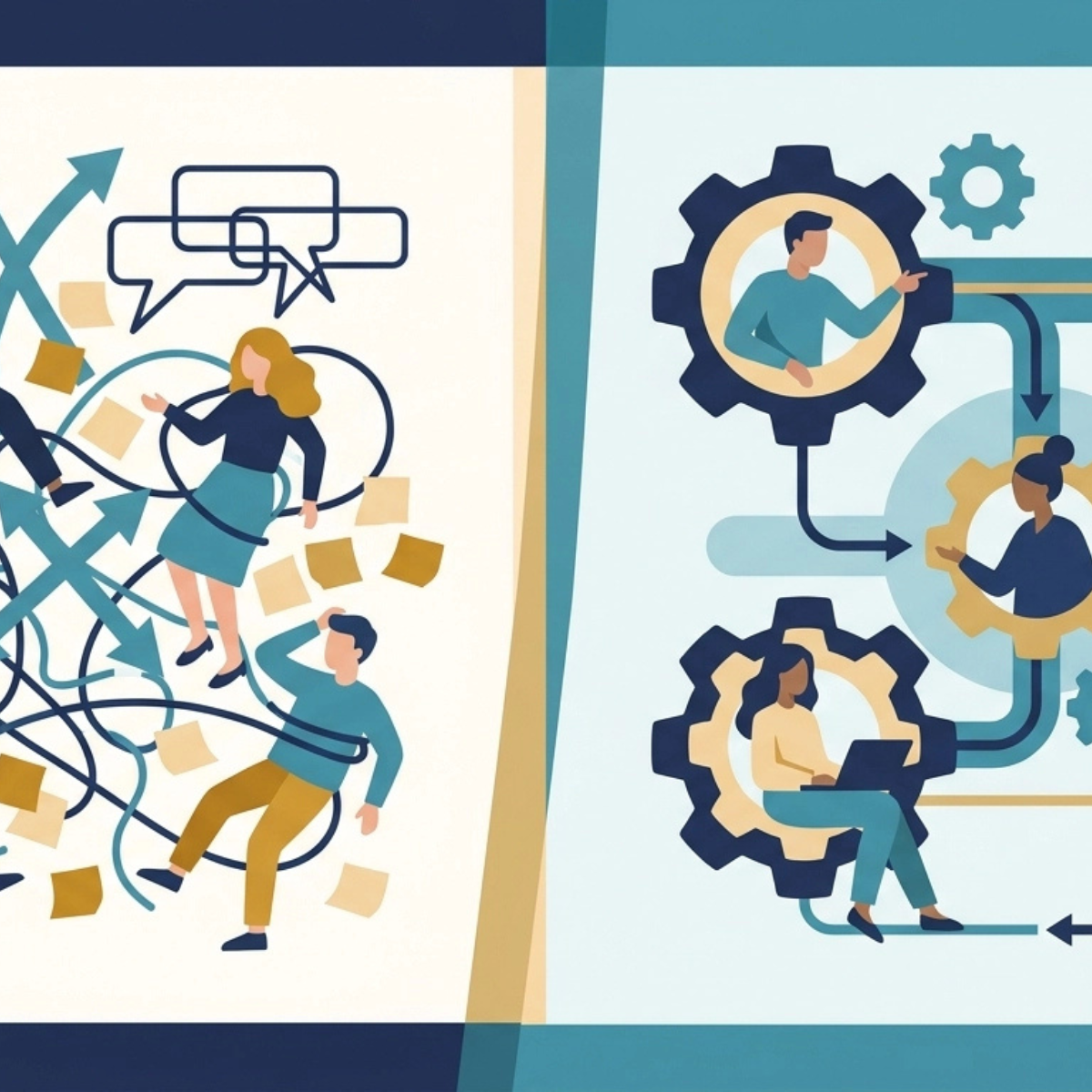
You’ve tried the “rah-rah” speeches. Added few new processes. You’ve probably even considered a new project management tool (spoiler: it won’t work). But the needle isn’t moving. Why? Because you’re treating a design problem like a people problem.
In my 25+ years leading Fortune 50 teams, I’ve seen it a hundred times. Leaders think they have “underperformers” when they actually have a broken system. They look for organizational effectiveness consulting when what they really need is to redesign their leadership.
If you’re ready for some tough love, let’s diagnose why your team is stuck in neutral.
1. The “Human Reminder App” Syndrome
If you have to follow up three times to get a status update, you aren’t leading; you’re a human ping. When accountability depends on your memory rather than a designed system, performance will always cap at your personal bandwidth.
The Fix: Shift from being the reminder to being the architect. Stop swooping in to save the day and start building systems where the work tracks itself. This is a core pillar of leadership coaching for managers.
2. Vague Expectations: The “Clear to Who?” Problem
You think you’ve set a clear goal. But is it clear to you or clear to them? Most stagnation happens in the gap between “I thought they knew” and “I had no idea.”
The Fix: Get uber clear. Instead of saying “I need this soon,” say “I need a 3-page draft of X by Thursday at 2 PM for the board review.” Clarity is kindness.
3. The Bottleneck Boss (The Hero Complex)
Are you the one who has to “touch” every deck, approve every email, and join every call? Congratulations, you are the reason your team is slow. By being the ultimate decision-maker for every minor detail, you’ve trained your team to stop thinking.

The Fix: Leadership design means creating a framework where your team can make 80% of the decisions without you. If they are bringing you problems instead of thinking, that’s a design flaw you need to fix.
4. The “Routine Trap”
Teams often get caught in internal loops: doing the same tasks because “that’s how we do it”: without ever looking at the external market. They are busy, but they aren’t effective.
The Fix: This is where performance management consulting comes in. You must systematically connect your team’s daily activity to external intelligence. If the work isn’t moving the needle on the actual business strategy, stop doing it.

5. Right People, Wrong Chairs
You might have A-players, but if your star receiver is playing defensive tackle, you’re going to lose. Stagnation often occurs when roles are designed around people rather than outcomes.
The Fix: Audit your team’s strengths against the needs of the business, not their current job titles. Leadership development isn’t all training; it’s also about alignment.
6. Productivity Theatre
If your calendar looks like a game of Tetris played by someone who hates you, you’re likely suffering from “Productivity Theatre.” When 40% of the week is spent talking about work, there’s no time to actually do the work.
The Fix: Audit every recurring meeting. If it doesn’t have a clear objective, an agenda, and a decision-maker, cancel it. Reclaim that space for deep, strategic execution.
7. The Feedback Vacuum: Niceness vs. Kindness
Is your team “nice”? That’s great for a dinner party, but it’s toxic for a high-performance team. When people are too polite to point out a flaw, mediocrity becomes the standard.
The Fix: Build a Feedback Bridge. Move from “You’re doing great” to “Here is the gap between your current output and the standard required for the next level.” Real leaders give real feedback.

8. Skill-Complexity Mismatch
Sometimes, the team isn’t lazy; they’re just drowning. If the complexity of the market has outpaced the skills of your team, pushing them harder will only cause burnout, not breakthroughs.
The Fix: Invest in targeted leadership development. If the job has evolved, the person must too.
9. Values on the Wall vs. Values in the Hall
If your company values say “Innovation” but you punish every mistake, your team will stop innovating. This cultural drift creates a massive friction point that slows everything down.
The Fix: Align your incentives with your stated values. If you want speed, stop rewarding perfect, slow work.
10. The Middle Management Cap
Your team’s performance is capped by the level of the person leading them. If your mid-level managers are just “glorified doers” rather than strategic architects, the whole organization stalls.
The Fix: This is why organizational effectiveness consulting must focus on leadership design at the middle layer. These leaders are the multipliers. If they are stuck, the whole engine is stuck.
Why Leadership Design is the Ultimate Unlock
When people talk about organizational effectiveness consulting, they often get bogged down in abstract theories and “fluff.” I don’t do fluff.
Organizational effectiveness is a design problem.
If your team is stagnant, don’t blame the people. Audit the design. Are the roles clear? Is the accountability automated? Is the feedback loop closed?
Most leaders are so busy being a “firefighter” that they forget they are supposed to be the architect of the station.
Stop being the bottleneck. Stop being the human reminder app. It’s time to shift from accidental leadership to intentional design.
Are You Ready to Break the Plateau?
If you’re tired of being the only one who cares about the results, let’s fix the system. Whether it’s through high-impact leadership coaching or a strategic deep dive into your team’s performance, I can help you identify those hidden gaps and close them for good.
Stop managing stagnation. Start designing performance.