

Let’s say the quiet part out loud:
Every January, high-achieving leaders come into the year fired up, goal-loaded, color-coded, and ready to dominate their results. Unfortunately, by March, they’re in full leadership burnout and doing internet searches on “Best vacation spots in March.”
Sound familiar?
The burnout creeps in fast.
Not in December when you expect it.
Not in Q4 when everyone else is tired.
Nope, for high performers, the crash usually comes around March.
Why? Because January pumps you full of energy and ambition. February buries you in responsibilities. By March, reality is sitting on your chest like an elephant, and you’re asking why you thought this was the year you’d magically grow eight extra hours a day.
Eight is the number of infinity but unfortunately, time is not infinite. Here’s the thing:
Burnout in March isn’t about time management. It’s really an energy management problem.
And if you’re not paying attention, you’ll repeat the same leadership burnout cycle every single year, like it’s your toxic leadership resolution.
Let’s break down why this happens and how to stop torching your energy before spring even hits.
Why High-Achievers Burn Out So Early in the Year
Most people imagine burnout creeping in slowly, like a slow leak in your vehicle’s tires.
But high achievers?
Burnout hits you like a punch from a heavyweight boxer.
And honestly, your strengths are what sets the trap, not your weaknesses. I know that sounds counterintuitive but hear me out on these six reasons high achievers experience leadership burnout so early in the year.
1. January Turns You into a Very Confident Overcommitter
January is really seductive. Especially if you frequently scroll on social media.
It’s all fresh-start energy, strategic planning sessions, new KPIs, resolutions, and your boss saying things like “This year we’re going to hit the ground running!”
You start stacking unrealistic commitments like you’re ordering from the buffet:
“Yes, I can lead that initiative.”
“Sure, I can take on the stretch assignment.”
“No problem, I can fix that dysfunctional cross-functional team.”
“Sure, I can mentor the new manager.”
“Yes, I’ll own the rollout.”
The January You thinks that you’re invincible.
March You is deer in the headlights blinking like, “Who made these decisions? I want their badge.”
Overcommitment is the fuel. Burnout is the flame.
2. You Start the Year Performing Instead of Leading
High-achieving leaders have a bad habit of trying to “prove themselves” at the start of the year.
You jump into doing mode:
doing more tasks, solving more problems, picking up the slack, and showing the organization just how much of a superhero you can be.
Take a minute to reflect on what being a superhero really means.
You save the world by putting yourself in harm’s way.
Your relationships suffer because you’re always needed somewhere by someone.
You’re performing while everyone stands by watching.
Except… leadership isn’t performance. Doing more work never buys you more influence.
It’s actually worse. It exhausts you before the real strategic work starts.
The more you perform, the faster you burn.
3. You Treat Your Energy Like an Unlimited Resource
Spoiler Alert: Your energy is not your local wholesale store.
It does not restock every day before sunrise.
Unfortunately, high achievers act like they’ve got an endless energy supply:
“I’ll sleep later.”
“It’s fine. I’ll power through.”
“I work better under pressure.”
“I’ll rest once this project is done.”
“Let me just check one more email.”
Before you know it, you’re living on caffeine, chaos, and pure adrenaline.
Energy debt is real, and the interest hits hard.
4. You’re Carrying Everyone’s Problems Except Your Own
This one is for leaders with big hearts and bigger responsibilities.
By March, you’re not only carrying your goals, your KPIs, your deadlines.
You’re also carrying:
▪ your boss’s deadlines
▪ your team’s dropped balls
▪ And all their fears, interpersonal drama, missed details, confusion, emotional needs and lack of clarity
You’re a leader, not a walking crisis hotline.
If you let everyone funnel their problems through you, you’ll burn out faster than you can say “I got it.”
Leadership is about supporting people, not absorbing their problems.
5. You Haven’t Adjusted Your Goals to Reality Yet
Let’s be honest: January goals are ambitious. You’re all inspired and energized.
Then February exposes all the things January did not consider:
▪ understaffing
▪ slow approvals
▪ budget changes
▪ unexpected fires
▪ evolving priorities
▪ your team’s actual capacity
▪ shifting organizational direction
By March, goals that once felt exciting now feel heavy, unrealistic, and out of sync with the real state of your role.
If you don’t recalibrate?
Burnout is guaranteed.
6. You Haven’t Built Enough Margin into Your Leadership
Burnout is less about doing too much and more about having no margin.
Margin = the space between your load and your limits.
Most high-achieving leaders run with zero margin because they complicate everything:
▪ Every presentation needs perfect wording.
▪ Every meeting must have a full slide deck.
▪ Every decision needs in-depth analysis.
▪ Every process needs to be perfect.
▪ Every fire must be put out by you.
Margin-less leadership is burnout on layaway.
What Burnout Looks Like in March (Even When You Don’t Call It Burnout Yet)
By March, leadership burnout doesn’t usually look like collapse or a mental breakdown.
It’s a slow unraveling. You may subtly see:
Your motivation tanking
You don’t feel excited anymore; you feel obligated.
Irritation over small things
Stuff you normally handle with ease suddenly feels catastrophic.
Cognitive fog
You’re present, but your brain isn’t.
“I’ll do it later” syndrome
Procrastination hits even the tasks you typically enjoy.
Emotional detachment
You stop caring. Not because you don’t want to, but because you can’t.
Sunday dread intensifying
Work feels heavier than it should, and you find yourself thinking about it on your off days.
Declining confidence
You start second-guessing things that used to be no-brainers.
Here’s the real danger:
High achievers don’t slow down when they’re burning out. They speed up.
They grab more tasks, push harder, over-function, and try to outwork their exhaustion.
That’s why the crash hits so early. You’re fighting your burnout instead of treating it.
The Real Reason Burnout Shows Up So Fast: You’re Leading Out of Alignment
Burnout isn’t caused by doing too much.
It’s caused by doing too much of the wrong things.
When what you’re doing doesn’t match your:
▪ strengths
▪ energy capacity
▪ values
▪ vision and goals
▪ role
▪ boundaries
…you’re operating in misalignment.
Alignment is a form of energy.
Misalignment drains it.
Most high-performing leaders crash early not because they’re incapable, but because they are misaligned, overcommitted, and under-supported.
Fix the alignment, and the energy returns.
How to Break the Burnout Cycle in 2026
Pivoting from diagnosis to strategy (because I think you get the point), below are the steps high-achieving leaders can take if they want to stop burning out before the second quarter.
1. Do a March Reset — Not a January Reset
January resets are about ambition.
March resets are about reality.
Ask yourself:
▪ Which goals still make sense?
▪ What needs to be delayed, delegated, or deleted?
▪ Which of my assumptions were wrong?
▪ What have I learned in the first two months?
▪ What is my real capacity versus my imagined capacity?
▪ Where are things draining me that shouldn’t be?
A March recalibration is where real leaders make real adjustments.
2. Stop Being the Team’s Safety Net
Here’s a bit of real talk:
If you’re rescuing everyone, you’re robbing them of growth and robbing yourself of energy.
Turn “I’ll handle it” into:
▪ “What do you think the best next step is?”
▪ “Go ahead and make the call — I trust you.”
▪ “What solutions have you already brainstormed?”
Delegating tasks is basic.
Delegating decisions is leadership.
3. Set Capacity Boundaries Like Your Career Depends on It (Because It Does)
Every leader needs three levels of boundaries:
Time boundaries
What you will not sacrifice anymore. Your time is valuable and should be focused on your vision and goals.
Workload boundaries
What you will not take on without negotiation. Identifying and negotiating the tradeoffs versus automatically adding more to your to-do list.
Emotional boundaries
What you will not absorb from others. This is how you manage your energy.
Boundaries don’t make you difficult.
They make you sustainable as a leader and a human. 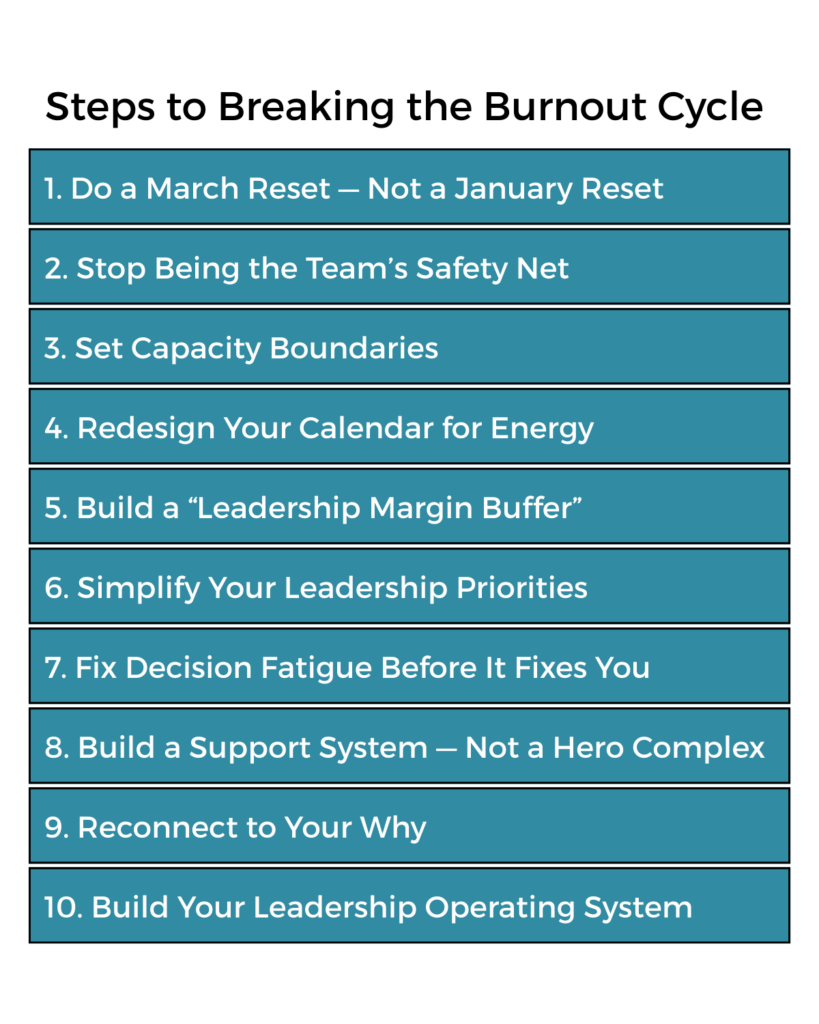
4. Redesign Your Calendar for Energy, Not Just Productivity
You don’t need more color-coded blocks. (Although believe me, the operations woman in me loves to see it!) But that just says you’re busy, not productive.
What you really need is space.
✔️ Block recovery time after intense meetings.
✔️ Schedule creative thinking when your energy is highest.
✔️ Push admin tasks to low-energy times.
✔️ Put non-negotiables on your calendar.
Your calendar is not a spreadsheet, it’s an energy map.
5. Build a “Leadership Margin Buffer”
Every week, create pockets of time for:
▪ strategic thinking
▪ planning ahead
▪ anticipating risks
▪ quiet work
▪ reset time
Your best leadership comes from intentional space, not mental, calendar chaos.
6. Simplify Your Leadership Priorities
High achievers often run on:
“I can do it all.”
But the leaders who thrive run on:
“I can do what matters most.”
Choose your top 3 leadership priorities for Q1.
Let everything else be negotiable.
7. Fix Decision Fatigue Before It Fixes You
Leadership burnout and decision fatigue are best friends.
If you don’t get control of your decisions, they will control your energy.
Use filters like:
▪ Should this be my decision or someone else’s? If not, delegate.
▪ Is this necessary? If not, that’s the decision.
▪ Is this aligned? If yes, proceed with your decision-making model.
▪ Is this the best use of my capacity? If not, the decision is a no.
▪ Am I the only person who can decide? If not, consider delegation.
The answer is “no” more often than you think. Many times, leaders don’t stop long enough to do the analysis then wonder why they have so much on their plate.
8. Build a Support System
Enter the Hero Complex. High achievers hate asking for help because they believe:
“If I don’t do it myself, it won’t be done right.”
Wrong.
You need:
▪ peer support
▪ coaches and mentors
▪ leadership development
▪ administrative support
▪ boundaries that protect your time
▪ processes that reduce chaos
Even Batman had the Justice League.
Leadership is not a solo sport.
Stop playing it like one.
9. Reconnect to Your Why
Nothing drains leaders faster than forgetting the purpose behind their work.
Ask:
▪ Why am I doing this? Afterwards, ask yourself again, “No really, why am I doing this?”
▪ What’s the long-term goal?
▪ What impact do I want?
▪ What matters to me as a leader?
▪ What am I no longer willing to sacrifice?
Clarity fuels energy.
Confusion drains it.
10. Build Your Personal Leadership Operating System
Your operating system answers how you:
▪ Make decisions
▪ Set priorities
▪ Communicate boundaries
▪ Delegate
▪ Show up
▪ Manage your energy
Without one?
You’re winging the most important job of your life.
With one?
You become unstoppable.
The Truth: Burnout in March is an Information Source
Burnout doesn’t mean you can’t handle the pressure.
It means something is misaligned.
Burnout doesn’t mean you can’t handle leadership.
It means you’ve been handling too much of the wrong leadership.
It doesn’t mean you’ve failed.
It means your system is trying to tell you something:
“This is not sustainable.”
The good news?
You get to rebuild the system.
2026 Is the Year You Lead Without Losing Yourself
I’ll give it to you straight:
You are too talented, too capable, too impactful, and too essential to keep burning out before the year even gets in full swing.
High-achieving leaders deserve momentum, not exhaustion.
You deserve clarity — not chaos.
You deserve support — not silent struggle.
You deserve to lead from fullness — not fumes.
And 2026 (or whatever year you’re reading this) can be the year you finally break the pattern.
Because once you stop treating burnout as the price of leadership?
You stop paying with your well-being.