Let’s go ahead and tell the truth most leaders privately admit but rarely say out loud:
You rarely get to lead, because you’re too busy reacting.
You don’t get to be strategic because you’re managing chaos.
You’re not thinking ahead because you’re putting out fires while hoping nothing else explodes.
Obviously, none of this is because you’re incapable. We know you have the skills and experience.
It’s because your job evolved, your responsibilities expanded, the expectations multiplied… but your mental space stayed the same size.
Here’s the good news:
Strategic thinking isn’t reserved for executives, business owners, or people who mysteriously have free time. It’s a skill. More importantly, it’s a system that real leaders in real jobs with real demands can develop.
Because honestly: reacting all day is not leadership. It’s survival.
Let’s walk through why so many leaders struggle with strategic thinking, the lies you’ve been sold about it, and what it actually takes to stop managing the moment and start leading from a higher level.
Why Leaders Struggle With Strategic Thinking
1. The Lie: “I Don’t Have Time to Be Strategic.”
This belief is holding leaders hostage across every industry.
Here’s why this thinking is wrong:
You DO have time, but your energy is too depleted to use it.
Most leaders try to think strategically at the worst possible time:
▪ at the end of a chaotic day
▪ after 8 meetings
▪ after coaching an underperformer
▪ while multitasking
▪ while stressed
▪ while already mentally fried
You can’t do high-level thinking on a low battery.
The issue isn’t time — it’s capacity.
2. You think strategy requires hours of quiet reflection.
Nope. Strategy is clarity + direction.
Most strategic breakthroughs happen in 10–20 focused minutes.
3. You think tactical work is more urgent.
Because it screams louder.
Strategic work whispers but has the biggest impact.
4. You weren’t taught how to be strategic.
Corporate culture tells people to be strategic but rarely teaches them how to think strategically.
So, leaders default to what they know:
work, react, respond, repeat.
But here’s the leadership pivot:
Strategic thinking isn’t about extra work — it’s the work that makes everything else easier.
What Strategic Thinking Actually Is (And What It Isn’t)
Let’s clear this up, because the confusion is costing leaders (you) promotions, influence, and peace of mind
Strategic thinking is NOT:
▪ endless brainstorming
▪ big fancy vision statements
▪ creating extensive PowerPoints
▪ predicting the future
▪ having a perfect plan
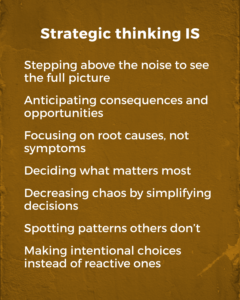
Strategic thinking IS:
▪ stepping above the noise to see the full picture
▪ anticipating consequences and opportunities
▪ focusing on root causes, not symptoms
▪ deciding what matters most
▪ decreasing chaos by simplifying decisions
▪ spotting patterns others don’t
▪ making intentional choices instead of reactive ones
Strategic thinkers aren’t smarter.
They’re clearer.
And they’re clearer because they’ve learned how to manage their attention, not just their tasks.
Why So Many Leaders Are Stuck in Reaction Mode
Listen, you’re not incompetent because you’re reacting all day.
You’re in reaction mode because you’ve been conditioned that way.
Here’s what’s working against you:
You’re drowning in urgent-but-not-important work.
Every day, leaders get sucked into:
▪ Teams pings
▪ emails
▪ “quick questions”
▪ fires that aren’t theirs
▪ unnecessary meetings
▪ status updates
▪ last-minute escalations
Urgency is a bully.
It takes over your entire day unless you set boundaries.
You’ve normalized speed over accuracy.
Most workplaces reward fast:
▪ fast replies
▪ fast fixes
▪ fast decisions
▪ fast reactions
But here’s the catch:
Fast rarely equals strategic.
Fast thinking keeps you busy.
Strategic thinking keeps you effective.
You’ve been promoted for doing — not thinking.
This is a big one.
As individual contributors, high performers get promoted because they execute well.
But once they become leaders, execution is no longer their primary job.
The problem?
No one tells them that.
And they definitely train them on it.
So leaders keep performing instead of leading.
And you end up doing the work you were supposed to outgrow.
You’re carrying too many decisions.
Decision fatigue kills strategy.
When your brain is overwhelmed with small decisions, it can’t elevate to big-picture thinking.
Strategic thinking requires:
✔️ mental space
✔️ emotional space
✔️ time
✔️ clarity
✔️ boundaries
If your day has none of those things, of course you can’t think strategically.
You’re addicted to solving problems.
Let’s be honest, high achievers love a good rescue mission.
It feels good to fix things.
>It feels efficient.
>It feels productive.
But constant problem-solving is not leadership — it’s maintenance.
Strategic leaders grow people so problems stop landing on their desk.
The Shift: From Reactive Leader to Strategic Leader
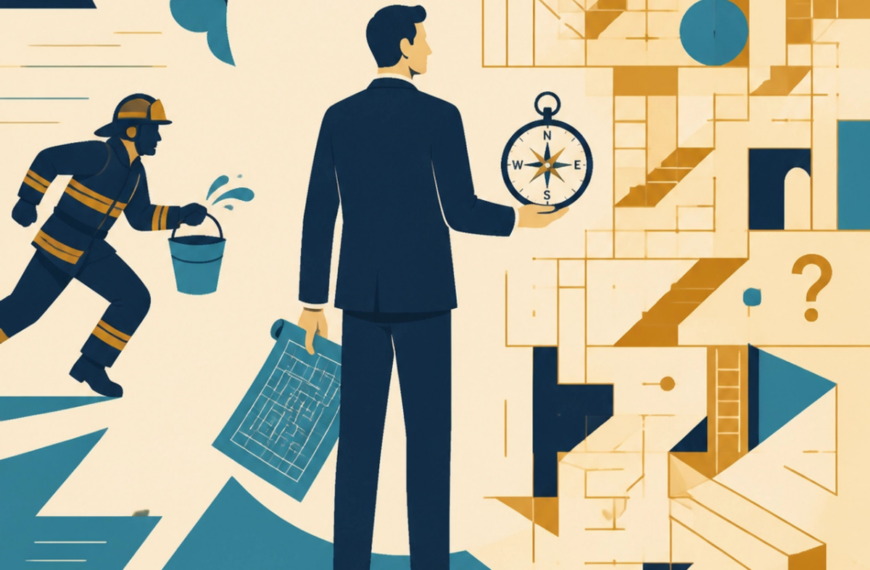
To be strategic, you need to stop operating like a firefighter and start operating like an architect.
Firefighting:
“What needs to be dealt with right now?”
Architecting:
“What needs to be true, so this problem doesn’t exist next quarter?”
See the difference?
Strategic leaders don’t just handle what happens.
They influence what happens next.
And that shift starts with learning to think differently.
Let’s break down how to do that.
How to Become a Strategic Thinker, Even When Chaos Surrounds You
Strategic thinking is not complicated, but it is structured.
Here are the systems and practices that leaders need to build their strategic muscles.
1. Create Space for Strategy — Don’t Wait for It
If you’re waiting for a slow day to think strategically, that day will arrive right after the unicorn parade. Be sure to invite me! In the meantime…
Strategy doesn’t appear. You schedule it.
Try this:
15-minute daily elevation window
Ask yourself:
▪ Am I clear on the real goal here?
▪ What pattern am I noticing?
▪ What requires my leadership, not my effort?
▪ How’s a smarter way to approach this?
Fifteen minutes.
That’s it.
Do that consistently and your leadership transforms.
Weekly big-picture review
▪ What moved the needle?
▪ Which things didn’t matter?
▪ What risks are emerging?
▪ What opportunities are appearing?
The most strategic leaders don’t think bigger — they think earlier.
2. Slow Down Your First Thought
Reactive thinkers respond.
Strategic thinkers pause.
A three-second delay can change an entire decision.
Questions to ask in that pause:
▪ What’s actually happening here?
▪ Do I understand the root problem?
▪ Is this urgent or just loud?
▪ Should this be mine?
▪ What outcome are we aiming for?
▪ What happens if we do nothing?
Slowing your initial impulse rewires your leadership brain.
3. Zoom Out Before You Zoom In
Reactive leaders zoom in first:
“What’s the issue?”
Strategic leaders zoom out first:
“How does this connect to everything else?”
Try this 3 Levels of Zoom process:
- Level 1: Big Picture
What’s the goal, context, and impact?
- Level 2: Systems View
Where’s the dependency or pattern?
- Level 3: Specific Issue
Now address the immediate need.
Flip the sequence = flip the outcome.
4. Ask Better Questions (This Is the Secret Sauce)
Strategic thinking is rooted in curiosity.
Here are the questions strategic leaders ask regularly:
Pattern Questions
- What keeps happening?
- What do the recurring issues tell me?
Impact Questions
- What’s the effect downstream?
- Who benefits or loses from each option?
Alignment Questions
- Does this support our bigger goals?
- Does this match our priorities?
Capacity Questions
- What do we actually have the bandwidth for?
- What should we stop doing?
Risk Questions
- What are we not seeing yet?
- What happens if we wait?
Reactive leaders ask, “What should we do right now?”
Strategic leaders ask, “What should we create or change so this doesn’t keep happening?”
5. Build Your Strategic Vocabulary
This is underrated but powerful.
If you want people to see you as strategic, you need to sound strategic.
That means using language that shows intention and impact.
Start using phrases like:
▪ “Here’s the bigger picture…”
▪ “Long term, this means…”
▪ “The opportunity I’m seeing is…”
▪ “This aligns with…”
▪ “To prevent this next time…”
▪ “What success looks like here is…”
You’re not being fancy.
You’re signaling leadership.
6. Lead With Principles, Not Preference
Strategic leaders don’t make decisions based on mood, fear, urgency, or people-pleasing.
They use principles.
Examples:
- Prioritizing impact over activity.
- Making decisions based on capacity and alignment.
- Not over-engineering solutions.
- Solving root causes, not symptoms.
When your principles are clear, your decisions are faster and smarter.
7. Delegate for Development, Not Relief
Most leaders delegate to remove things off their plate.
Strategic leaders delegate to:
▪ grow capability
▪ prepare people for higher roles
▪ build decision-makers
▪ reduce future bottlenecks
Strategic delegation reduces tomorrow’s fires — not just today’s tasks.
8. Protect Your Thinking Time
Strategic thinking is where leaders develop vision, create direction, prevent burnout, reduce chaos, anticipate issues, shape culture, and influence outcomes.
This is executive-level behavior, no matter your title.
If you don’t protect your thinking time, the job will consume it.
9. Know When to React — and When to Lead
Strategic thinking does not mean you never react.
It means you’re intentional about when you do.
There are three modes:
▪ Reactive — address immediate issues.
▪ Responsive — assess and choose the right move.
▪ Strategic — shape the path forward.
Good leaders move between modes consciously.
Burned-out leaders stay stuck in reactive mode all year.
Why Leaders Who Think Strategically Advance Faster
Here’s the truth the boss isn’t saying out loud:
Strategic leaders are the ones who get promoted.
Reactive leaders get stuck.
Strategic leaders are seen as:
▪ clear thinkers
▪ problem preventers
▪ high-impact decision-makers
▪ big-picture leaders
▪ change navigators
▪ influencers
▪ reliable voices
When you think strategically, people trust you differently.
They see you differently.
They choose you for different opportunities.
You stop looking like a worker.
You start looking like a leader.
The Reality Check: You Can’t Lead Strategically in Survival Mode
Truth be told, you can’t elevate your thinking while:
▪ exhausted
▪ overwhelmed
▪ under-supported
▪ drowning in tasks
▪ unclear about priorities
▪ afraid to say no
▪ afraid to delegate
▪ lacking boundaries
Survival mode suppresses strategy.
Period.
If you want to think strategically, you need:
▪ mental margin
▪ emotional space
▪ capacity
▪ clarity
▪ boundaries
▪ systems
▪ support
Because when your mind has room, your leadership expands.
The Leadership Shift: Strategic Thinking is a Habit, Not a Talent
Strategic thinkers are consistent. That’s the major difference.
They:
▪ schedule thinking time
▪ pause before reacting
▪ zoom out regularly
▪ ask better questions
▪ look for patterns
▪ create alignment
▪ eliminate noise
▪ simplify decisions
▪ build systems around their strengths
This is learnable.
It is buildable.
And it’s repeatable.
And once you learn it, no one can take it away from you.
Strategy is a Must
If you want to stop being seen as the “go-to person who gets things done”, then you have to raise your leadership standard. Raising your leadership standard will help you start being recognized as a leader who shapes direction, influences outcomes, and drives meaningful impact.
Strategic leaders create space to get the clarity they need.
They don’t wait for direction, they define it.
They don’t wait for fires; they eliminate the conditions that cause them.
And the moment you stop reacting and start leading with intention?
Influence grows.
Confidence grows.
Opportunities grow.
Your career expands in ways you didn’t think were possible.
Strategic thinking isn’t just a leadership skill.
It’s a leadership identity.
And this is the year you step fully into it.